The Case for Proactive Revenue Cycle Management
Here is something worth sitting with for a moment.
Most billing teams are genuinely good at working denials. Fast turnaround, solid follow-up, strong appeal rates. And yet the same denial reasons keep showing up month after month. The queue never actually shrinks – it just keeps refilling.
This is not a staff performance problem. It is a workflow design problem. The denial didn’t begin when the payer rejected the claim. It began days, sometimes weeks, earlier. At patient registration, during the coding,n or in a prior authorization request that wasn’t followed up on before the appointment.
By the time a denial lands in your billing queue, the mistake that caused it is long gone. The only question left is how much of the revenue you can recover – and how much just disappears.
There is a better way to think about this. Stop managing denials. Start preventing them.
Denial Rates Are Climbing – and the Root Cause Is Not What You’d Expect
The numbers coming out of recent industry surveys are not encouraging for anyone running a revenue cycle right now.
Experian Health’s State of Claims 2025 report – which surveyed 250 revenue cycle leaders across U.S. healthcare – found that 41% of providers now report denial rates of 10% or higher. That figure was 30% in 2022. Three years, and denial rates have moved that sharply in the wrong direction. The same report found that 68% of providers say submitting clean claims is harder today than it was a year ago.
Payers are tightening requirements. Medicare Advantage plans in particular have become significantly more aggressive in claims review – with commercial and MA denials both rising from 2023 to 2024 according to OS Healthcare’s denial rate index analysis published in 2025.
And here’s what gets missed in most of these conversations: the number one cause of rising denials is not payer aggression or coding complexity.
It is inaccurate or incomplete data collected at patient registration. Per the same Experian Health report, missing or inaccurate claim data was cited by 50% of respondents as their primary driver of rising denials – up from 46% the year before. More than a quarter of providers said at least 10% of their denials trace directly back to intake errors.
A wrong digit in a member ID, an insurance plan that lapsed and was never re-verified, a prior auth requirement nobody flagged at scheduling. These are not complex billing problems. They are data collection failures that happen at the front desk and surface as claim rejections 30 days later.
Fixable. All of it. But only if you catch them before the claim goes out – not after.
Reactive Management vs. Actual Prevention
Most denial management programs are built to handle denials well. Fast appeal workflows, good follow-up cadence, solid recovery rates. Nothing wrong with any of that – but it is still reactive. You are recovering revenue that should not have been put at risk in the first place.
Proactive denial prevention is a different posture entirely. It means building checkpoints into your workflow that catch errors before the claim ever leaves your system.
The financial case for prevention is straightforward. Per MGMA’s 2024 denial benchmarking data, up to 15% of claims are denied or delayed – and nearly two-thirds of those are recoverable if the practice has the systems to work them. The ones that aren’t recovered represent permanent revenue loss. Not delayed. Gone.
For most small and mid-size practices, the bandwidth to systematically work every single denial simply doesn’t exist. Some get appealed. Some get resubmitted. A portion just falls through and the revenue disappears quietly, month after month, without anyone tracking the cumulative impact.
The better investment is stopping the denial from happening. And that means rethinking where in your workflow errors are actually being introduced.
Where the Errors Actually Enter the Workflow
Walk through a typical claim cycle and the exposure points become obvious.
A patient books an appointment. Nobody checks whether their insurance is still active or whether the scheduled procedure requires prior authorization. They come in, receive care, and the provider documents the visit.
The documentation moves to billing. A coder assigns CPT and ICD-10 codes – sometimes manually re-entering information from the clinical record, sometimes working from a summary that doesn’t capture everything in the note. The claim gets submitted.
Three weeks later, a denial comes back. Wrong payer ID. Missing modifier. Auth required. Coverage lapsed.
Every one of those failure points had an earlier moment where it could have been caught. The lapsed coverage could have been caught at scheduling. The auth requirement could have been flagged before the appointment. The missing modifier could have been caught in a pre-submission validation check.
Instead, they turn into denials and now you’re paying to fix what could have been prevented.
The consistent culprits, backed by the Experian Health 2025 data, are:
- Missing or inaccurate patient and insurance data collected at intake
- Prior authorization requirements not identified before the service is delivered
- Coding errors – incorrect CPT/ICD-10 combinations, missing modifiers, NCCI bundling conflicts
- Eligibility not re-verified before the visit for returning patients
None of these are mysteries. They follow predictable patterns. Which means a system built to intercept them will catch the same issues before submission every time – rather than discovering them again on the denial remittance.
How MDCharts Is Built to Catch This Earlier
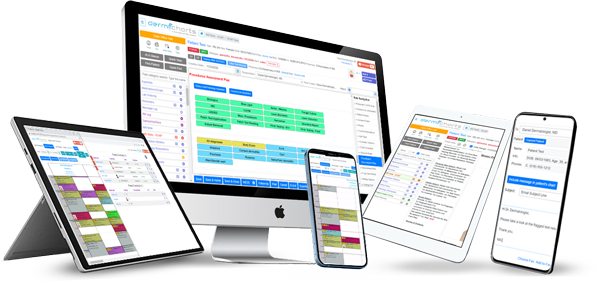
MDCharts is an integrated EHR and RCM platform – clinical documentation, coding, and billing in the same system. That matters here because most handoff errors happen at the seams between disconnected tools. When the provider documents in one system, the biller codes in another, and the claim is submitted through a third, each transition is a point where data can be lost, misread, or re-entered incorrectly.
With MDCharts, that chain is shorter. Here is what is actually in place:
Eligibility Verification Before the Encounter
MDCharts verifies insurance eligibility before the patient is seen – active coverage status, copay requirements, and authorization flags for scheduled procedures. Not a manual phone call to the payer. Not something the front desk has to remember to do. A verification that runs as part of the scheduling and check-in workflow.
This is the single highest-impact step in denial prevention. Catching a lapsed coverage situation or a missing auth requirement before the appointment happens prevents a category of denials that practices deal with constantly – and avoids the uncomfortable conversation with the patient after the fact.
Superbill Tied Directly to the Clinical Encounter
In MDCharts, the superbill flows from the clinical documentation. Diagnosis codes, procedure codes, and modifiers are connected to what was actually documented and ordered in the encounter – not re-entered manually by a biller working from a summary or a handwritten note.
This removes a translation step. And translation steps, in billing, create errors. The coder is still applying judgment – the platform doesn’t replace that – but the raw material they are working from is the actual clinical record, not a downstream copy of it.
Claim Validation Before Submission
Before a claim leaves MDCharts through the clearinghouse, it runs through validation checks. Mismatched diagnosis and procedure code combinations get flagged. Missing required fields surface. NCCI edit conflicts are caught.
Claims that fail this check don’t go out until someone reviews and corrects the issue. A denial that never happens costs nothing to work. That is the logic behind this step.
Denial Pattern Tracking Over Time
When denials do come back – and some always will – MDCharts tracks them by reason code and payer. CO-4, CO-16, CO-97, PR-1 – patterns build over time. If the same CARC code keeps appearing from the same payer for the same procedure range, that is a signal something upstream needs to change, not just another denial to work.
That is how the data from your denial history becomes a tool for process improvement rather than just a queue management problem.
A Scenario Worth Walking Through
A specialty practice was seeing recurring denials from one commercial payer – always the same procedure code range, always the same denial reason. The billing team was working them efficiently. Most were overturned on appeal. It was treated as a normal part of operations.
When the root cause was examined, the issue had nothing to do with how the appeals were being handled. The payer had updated their prior authorization requirements for that procedure category in a policy change. The change had not been caught. Claims were going out without the required auth, and every one of them came back denied.
Once the authorization requirements were updated in MDCharts and eligibility flagging was configured for that payer’s current rules, the denials for that code range stopped. The team hadn’t been making a billing error. They were operating on outdated assumptions – and without a system that checks auth requirements at the point of scheduling, there was no early warning.
The fix was configuration, not headcount. The denials had been running for months before anyone traced them to a policy update rather than a billing mistake.
Three Questions Worth Asking Right Now
Before investing in any new denial management workflow or technology, these three questions will tell you whether your problem is upstream or downstream – and that determines what kind of fix actually helps.
- What are your top five denial reason codes by volume over the last 90 days?
- What percentage of those trace back to eligibility or registration errors at intake?
- How many denied claims from last quarter were never resubmitted at all?
If the answers point upstream – which they usually do – the solution is not a faster appeal process. It is catching the errors before the claim leaves. That is where the conversation with MDCharts starts.
Reach out to the MDCharts team to walk through your specific denial patterns and billing setup.
Sources: Experian Health State of Claims 2025 (September 2025) | MGMA Denial Management Benchmarking 2024 | AMA Prior Authorization Physician Survey 2024 | OS Healthcare Denial Rates Index 2025